
It is hard to exaggerate the impact of the polymerase chain reaction. PCR, the quick, easy method for generating unlimited copies of any fragment of DNA, is one of those scientific developments that actually deserves timeworn superlatives like "revolutionary" and "breakthrough."
First described only 10 years ago, in its short life PCR has transformed the life sciences utterly. From the daily practicalities of medical diagnosis to the theoretical framework of systematics, from courts of law to field studies of animal behavior,
PCR takes analysis of tiny amounts of genetic material-even damaged genetic material-to a new level of precision and reliability. "PCR is the most important new scientific technology to come along in the last hundred years," says Mark R. Hughes, deputy director of the National Center for Human Genome Research at the National Institutes of Health (perhaps better known as the Human Genome Project). And Science has pointed out that, because it is far simpler and less expensive than previous techniques for duplicating DNA, PCR has democratized genetic research, putting it within reach of all biologists, even those with no training in molecular biology.
The central scientific fact that makes PCR so useful is this: The genetic material of each living organism-plant or animal, bacterium or virus-possesses sequences of its nucleotide building blocks (usually DNA, sometimes RNA) that are uniquely and specifically present only in its own species. Indeed, complex organisms such as human beings possess DNA sequences that are uniquely and specifically present only in particular individuals. These unique variations make it possible to trace genetic material back to its origin, identifying with precision at least what species of organism it came from, and often which particular member of that species.
Such an investigation requires, however, that enough of the DNA under study is available for analysis-which is where PCR comes in. PCR exploits the remarkable natural function of the enzymes known as polymerases. These enzymes are present in all living things, and their job is to copy genetic material (and also proofread and correct the copies). Sometimes referred to as "molecular photocopying," PCR can characterize, analyze, and synthesize any specific piece of DNA or RNA. It works even on extremely complicated mixtures, seeking out, identifying, and duplicating a particular bit of genetic material from blood, hair, or tissue specimens, from microbes, animals, or plants, some of them many thousands-or possibly even millions-of years old.
So simple is the PCR process, at least to molecular biologists, that its inventor, Kary Mullis, says their universal reaction has always been, "Why didn't I think of that?" Among the host of scientific prizes heaped on Mullis for the very bright idea he says came to him during a 1983 moonlight drive in the California mountains are two of the best known, the Japan Prize and the Nobel, both awarded to him in 1993.
PCR requires a template molecule-the DNA or RNA you want to copy-and two primer molecules to get the copying process started. The primers are short chains of the four different chemical components that make up any strand of genetic material. These four components are like bricks or building blocks that are used to construct genetic molecules; in the lab they are called nucleotides or bases.
DNA itself is a chain of nucleotides. Under most conditions, DNA is double-stranded, consisting of two such nucleotide chains that wind around each other in the famous shape known as the double helix. Primers are single-stranded. They consist of a string of nucleotides in a specific order that will, under the right conditions, bind to a specific complementary sequence of nucleotides in another piece of single-stranded RNA or DNA.
For PCR, primers must be duplicates of nucleotide sequences on either side of the piece of DNA of interest, which means that the exact order of the primers' nucleotides must already be known. These flanking sequences can be constructed in the lab, or purchased from commercial suppliers.
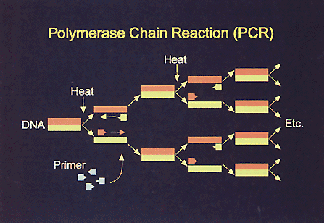
There are three basic steps in PCR. First, the target genetic material must be denatured-that is, the strands of its helix must be unwound and separated-by heating to 90-96°C. The second step is hybridization or annealing, in which the primers bind to their complementary bases on the now single-stranded DNA. The third is DNA synthesis by a polymerase. Starting from the primer, the polymerase can read a template strand and match it with complementary nucleotides very quickly. The result is two new helixes in place of the first, each composed of one of the original strands plus its newly assembled complementary strand.
All PCR really requires in the way of equipment is a reaction tube, reagents, and a source of heat. But different temperatures are optimal for each of the three steps, so machines now control these temperature variations automatically.
To get more of the DNA you want, just repeat the process, beginning by denaturing the DNA you've already made. The amount will double every time. With the cycle of rapid heating and cooling controlled automatically, nature-aided by scientist-supplied primers, polymerase, nucleotides, and chemical reagents-does the rest. Each cycle takes only 1-3 minutes, so repeating the process for just 45 minutes can generate millions of copies of a specific DNA strand. Once the primers have been characterized and obtained, PCR can do in a week work that used to take a year.
Of course, some technical problems can arise with PCR. The most important is contamination of the sample with extraneous genetic material that could generate numerous copies of irrelevant DNA. The result will often simply be useless, but sometimes can lead to erroneous conclusions. Laboratories take special precautions against the accidental introduction of even a few molecules of a contaminant-especially amplified DNA from previous experiments. Preventing contamination is a special challenge in human applications, such as medicine or the law, where someone's life may literally hang in the balance. Rapid automated PCR has been the key to the extraordinary upsurge in its applications throughout the life sciences. And the key to the process's automation has been Taq polymerase. Taq is a nickname for Thermus aquaticus, a bacterium that happily survives and reproduces in an environment that is lethal to other organisms: hot springs. That is why the organism's polymerase is perfectly at home in the rapidly fluctuating temperatures of automated PCR. Unlike other polymerases, the enzyme extracted from Taq (and now made in commercial quantities by genetically engineered bacteria) is stable at high temperatures. The microbiologists who found these remarkable organisms decades ago, and then spent years studying their physiology and biochemistry, had no way of knowing how crucial their work would become to human health, to the forensic sciences, or to the economy.
Human Health and the Human Genome Project
PCR has very quickly become an essential tool for improving human health and human life. Medical research and clinical medicine are profiting from PCR mainly in two areas: detection of infectious disease organisms, and detection of variations and mutations in genes, especially human genes. Because PCR can amplify unimaginably tiny amounts of DNA, even that from just one cell, physicians and researchers can examine a single sperm, or track down the elusive source of a puzzling infection. These PCR-based analyses are proving to be just as reliable as previous methods-sometimes more so-and often much faster and cheaper.
The method is especially useful for searching out disease organisms that are difficult or impossible to culture, such as many kinds of bacteria, fungi, and viruses, because it can generate analyzable quantities of the organism's genetic material for identification. It can, for example, detect the AIDS virus sooner during the first few weeks after infection than the standard ELISA test. PCR looks directly for the virus's unique DNA, instead of the method employed by the standard test, which looks for indirect evidence that the virus is present by searching for antibodies the body has made against it.
PCR can also be more accurate than standard tests. It is making a difference, for example, in a painful, serious, and often stubborn misfortune of childhood, the middle ear infection known as otitis media. The technique has detected bacterial DNA in children's middle ear fluid, signaling an active infection even when culture methods failed to detect it. Lyme disease, the painful joint inflammation caused by bacteria transmitted through tick bites, is usually diagnosed on the basis of symptom patterns. But PCR can zero in on the disease organism's DNA contained in joint fluid, permitting speedy treatment that can prevent serious complications.
PCR is the most sensitive and specific test for Helicobacter pylori, the disease organism now known to cause almost all stomach ulcers. Unlike previous tests, PCR can detect three different sexually transmitted disease organisms on a single swab (herpes, papillomaviruses, and chlamydia) and can even distinguish the particular strain of papillomavirus that predisposes to cancer, which other tests cannot do.
In short, if a disorder is caused by an infectious agent, PCR can, in principle, ferret out the culprit. More than 60 PCR protocols for identifying pathogens have been described to date, and at least 10 clinical products are available for detecting the evasive organisms that cause such diseases as tuberculosis, chlamydia, viral meningitis, viral hepatitis, AIDS, and cytomegalovirus.
Because PCR can easily distinguish among the tiny variations in DNA that each of us possess and that make each of us genetically unique, the method is also leading to new kinds of genetic testing. These tests diagnose not only people with inherited disorders, but also people who carry deleterious variations, known as mutations, that could be passed to their children. (These carriers are usually not themselves affected by the mutant gene, which they can lead to disease in the next generation.)
Research is expected eventually to yield predictive tests: methods for finding out who is predisposed to common disorders we do not customarily consider genetic, such as heart disease, and the cancers that can arise in adulthood via mutations in body cells. This knowledge will help us take steps to prevent those diseases, which are the chief killers in the developed world. With PCR analysis of cells shed into feces, for example, doctors have already demonstrated premalignant changes in the gastrointestinal tract, such as mutations in genes that protect against tumors. This can help them select high-risk candidates for colon cancer tests. Researchers have also detected potentially metastatic cells in the circulation of patients with newly diagnosed tumors.
PCR can provide enormous peace of mind to people who are trying to have children- for example, by reassuring anxious parents-to-be that they run no risk of having a child with a particular genetic disease. The technique even saves the lives of babies before they are born: doctors have used it for examining fetal DNA to learn whether the blood groups of mother and fetus are incompatible. This condition often leads to severe disability and even death of the fetus, but can be treated successfully in the womb with enough advance warning-thanks to PCR.
This process is also a direct way of distinguishing among the confusion of different mutations in a single gene, each of which can lead to a disorder such as Duchenne muscular dystrophy. It helps doctors track the presence or absence of DNA abnormalities characteristic of particular cancers, so that they can start and stop drug treatments and radiation therapy as soon as possible. And it promises to greatly improve the genetic matching of donors and recipients for bone marrow transplantation.
PCR can even diagnose the diseases of the past. Former vice president and presidential candidate Hubert H. Humphrey underwent tests for bladder cancer in 1967. Although the tests were negative, he died of the disease in 1978. In 1994, researchers compared a 1976 tissue sample from his cancer-ridden bladder with his 1967 urine sample. With the help of PCR amplification of the small amount of DNA in the 27-year-old urine, they found identical mutations in the p53 gene, well-known for suppressing tumors, in both samples. "Humphrey's examination in 1967 may have revealed the cancerous growth if the techniques of molecular biology were as well understood then as they have become," the researchers said.
Historical medical genetics has gone even further back in time with PCR. After the color-blind British chemist John Dalton died in 1844, some tissue from his eyes was preserved. Dalton had asked for a posthumous investigation of the reason why he confused scarlet with green and pink with blue. A recent examination of DNA taken from that tissue, carefully amplified by PCR, has shown that Dalton lacked a gene for making one of the three photopigments essential for normal color vision.
Many of the new genetic tests are the result of the Human Genome Project, the huge international effort to identify and study all human genes. Scientists expect the Human Genome Project to be finished shortly after the turn of the century. It is moving more rapidly than originally expected toward its ultimate goal, which is to sequence all the DNA in typical human cells. ("Sequence" means to determine the precise order of the four different nucleotides that make up any strand of DNA.) DNA sequencing reveals crucial variations in the nucleotides that constitute genes. These mutational changes produce disease and even death by forcing the genes to produce abnormal proteins, or sometimes no proteins at all.
DNA sequencing involves first isolating and duplicating DNA segments for nucleotide analysis. Thus PCR is an essential tool for the Human Genome Project because it can quickly and easily generate an unlimited amount of any piece of DNA for this kind of study.
The technique's unparalleled ability to identify and copy the tiniest amounts of even old and damaged DNA has proved exceptionally valuable in the law, especially the criminal law. PCR is an indispensable adjunct to forensic DNA typing-commonly called DNA fingerprinting.
To type DNA, for example DNA extracted from blood found on a murder suspect's clothes, scientists study a handful of sites on the DNA where variation among individuals is typical. This helps them determine the likelihood that the sample matches the DNA of a specific person, for example a stabbing victim. Although in its early days DNA typing was controversial, laboratory standards have been established, and carefully done DNA typing is now accepted as strong evidence in courts throughout the world. Defendants' attorneys continue to argue about the population frequencies of certain variant stretches of DNA, but a recent major scientific commentary concluded, "the DNA fingerprinting controversy has been resolved."
DNA typing is only one of many pieces of evidence that can lead to a conviction, but it has proved invaluable in demonstrating innocence. Dozens of such cases have involved people who have spent years in jail for crimes they did not commit. One example is Kirk Bloodsworth. The Maryland waterman was wrongly imprisoned for almost nine years for the rape and murder of a 9-year-old girl, but was freed in 1993 with the aid of PCR. Even when evidence such as semen and blood stains is years old, PCR can make unlimited copies of the tiny amounts of DNA remaining in the stains for typing, as it did in Bloodsworth's case.
Archaeologists have happily seized on PCR and are applying it in an amazing variety of ways. It is helping, for example, to launch a new chapter in the colorful and controversial story of the 2000-year-old Dead Sea Scrolls, which are written on parchment made out of skins from goats and gazelles. Researchers are analyzing the parchment fragments to try to identify individual animals they came from. The hope is that the genetic information will guide them in piecing together the 10,000 particles of scrolls that remain.
PCR is also helping sort out relationships among vanished human groups, and tracing human migrations. Studies on human brains that survived 8,000 years in a Florida sinkhole more or less intact indicate, for example, that the people who lived there were genetically different from today's Native Americans.
Archaeologists are finding that PCR can illuminate human cultural practices as well as human biology. Analyzing pigments from 4000-year-old rock paintings in Texas, they found one of the components to be DNA, probably from bison. The animals did not live near the Pecos River at that time, so the paleo-artists must have gone to some effort to obtain such an unusual ingredient for their paint. Taking so much trouble suggests that the paintings were not simply decorations, but had religious or magical significance.
PCR can faithfully copy bits of DNA whose age numbers in the thousands-some say millions-of years. Indeed, PCR's special strengths may be best revealed in the domain that has come to be known as Ancient DNA, where minuscule amounts of archaic, badly damaged genetic material are the norm. Ancient DNA studies generally fall under either the traditional concerns of archaeology, or of evolutionary biology-even the biology of organisms that disappeared long ago.
Scientists have used PCR to correct errors in a previous analysis of DNA from the 140-year-old skin of the last quagga, an African member of the horse family. The new genetic analysis has shown that the quagga was more closely related to the zebra than to any other horselike creatures. By amplifying and analyzing DNA from bone and mummified soft tissue, scientists have also found that moas, a group of large New Zealand birds that were hunted to extinction, are not related to the still-extant New Zealand kiwi, despite the fact that both bird species could not fly. Leaping far back in time, researchers have suggested, however, that termites imprisoned in amber 40 million years ago differed little from the termites of today.
But DNA need not be ancient to provide information about evolutionary relationships. With PCR, systematists can measure differences in DNA sequences between species directly, and if they select sequences that have changed little during evolution, between major classes of organisms. The speed and automation of the process means that scientists can easily compare dozens or even hundreds of individuals, putting their conclusions on a firmer basis.
With PCR, scientists can glean genetic information from the faintest traces of the shyest, rarest animal-urine, feces, scent marks, infinitesimal bits of hair or skin rubbed onto a tree as the elusive creature passes by. In addition to information that aids classification, individuals can be identified so as to estimate population size in a particular locale, or to determine the geographic range of a single animal, or a group of them. The technique can be adapted to similar studies of plants, for analysis of patterns of seed dispersal and the relative reproductive success of specific plants. Researchers have even used PCR to study badly damaged specimens such as roadkill, or the leavings of carnivores, where little-known vertebrates have been identified among the prey.
Because PCR does not require invasive samples of blood or other tissue, research need not disrupt an animal's lifestyle-a boon for behavioral studies-and should not distress people concerned about animals. DNA extracted from feces, for example, is being explored to find out which of the approaches to mating common among olive baboons work best, by establishing which males actually are successful at fathering infants.
Researchers have used the technique to aid in reducing illegal trade in endangered species, and products made from them. Because PCR is a relatively low-cost and portable technology, and likely to become more so, it is adaptable for field studies of all kinds in the developing countries. It is also a tool for monitoring the release of genetically engineered organisms into the environment.
The present technology for doing PCR, about the size of a microwave oven and costing several thousand dollars, seems destined for further radical improvement. By tinkering with variables such as chemical reagents and pH, researchers have already reported success at copying larger and larger pieces of DNA, including the entire genome of HIV.
Extraordinary miniaturization of the hardware is also underway, as experimenters squeeze PCR onto chip-sized devices. Crisscrossed with the tiniest of troughs to hold the reagents and the DNA, the chips are heated electrically and cool down much faster than the present generation of machines, so amplification is even speedier than today's swift process. Already researchers have reported using a handheld battery-powered gadget to copy pieces of DNA that contained eight different cystic fibrosis mutation sites.
While such experimental chip-based devices are not yet ready for prime time, they are hastening the day when scientists can take them on the road, and patients will be able to get on-the-spot readouts of their DNA. Before long it may be quite routine to diagnose an infectious or genetic disorder, or even detect an inherited predisposition to cancer or heart disease, right in the doctor's office.
PCR is doing for genetic material what the invention of the printing press did for written material-making copying easy, inexpensive, and accessible. In principle, PCR can reproduce the genetic material of any organism in essentially unlimited quantities, so it can be used to analyze any cells containing that material. Whether they are germs, rare medicinal plants, or human beings, eventually we can know whatever is recorded in their DNA. With simple organisms, to know their DNA will be to know almost everything about them. With complicated ones, like people, DNA is only part of the story, but a very big part. Thanks to PCR, we will be probing the genetic past, and peering into the genetic future, for many years to come.
Kary Mullis tells how the idea for PCR came to him out of the blue in "The Unusual Origin of the Polymerase Chain Reaction," Scientific American, April 1990, pp. 56-65.
The medical applications of PCR change almost daily. A.F. Markham reviewed many of them in "The Polymerase Chain Reaction: A Tool for Molecular Medicine," British Medical Journal 306:441?447, February 13, 1993. PCR applications are also explored in a recent series of short articles on molecular medicine appearing in The New England Journal of Medicine. See especially two articles by Stephen P. Naber: "Molecular Pathology: Diagnosis of Infectious Disease" (331:1212?1215, November 3, 1994) and "Molecular Pathology: Detection of Neoplasia" (331:1508-1510, December 1, 1994.) See also "Human DNA Polymorphism" by David Housman (332:318-320, February 2, 1995) and "Molecular Diagnosis" by Bruce Korf (332:1499-1502, June 1, 1995).
For everything you ever wanted to know about PCR and the field of genetics, consult the second edition of Recombinant DNA, by James D. Watson, Michael Gilman, Jan Witkowski, and Mark Zoller (Scientific American Books, 1992.) It contains an entire chapter on PCR, and discussions of many of the technique's applications in genetics are sprinkled throughout.
An immense amount has been written about the forensic uses (and misuses) of DNA analysis via PCR; some of it has probably appeared in your local newspaper. For an authoritative overview, see Genetic Witness: Forensic Uses of DNA Tests, a substantial report by the Office of Technology Assessment of the U.S. Congress. (U.S. Government Printing Office, OTA-BA-438, July 1990.) For a recent slant that emphasizes the complications of PCR as a forensic tool, see Jon Cohen, "Genes and Behavior Make an Appearance in the O.J. Trial," Science 268:22-23, April 7, 1995.
"Ancient DNA" was described by its leading authority, Svante Pääbo, in Scientific American, November 1993, pp. 87-92.
The virtually unlimited uses of PCR in evolutionary biology, zoology, botany, animal behavior, conservation biology, environmental science, and ecology were reviewed by Norman Arnheim, Tom White, and William E. Rainey in "Application of PCR: Organismal and Population Biology," BioScience 4:174-182, March 1990.
Survey PCR's future technology with Robert F. Service, who described "The Incredible Shrinking Laboratory," in Science 268:26-27, April 7, 1995